
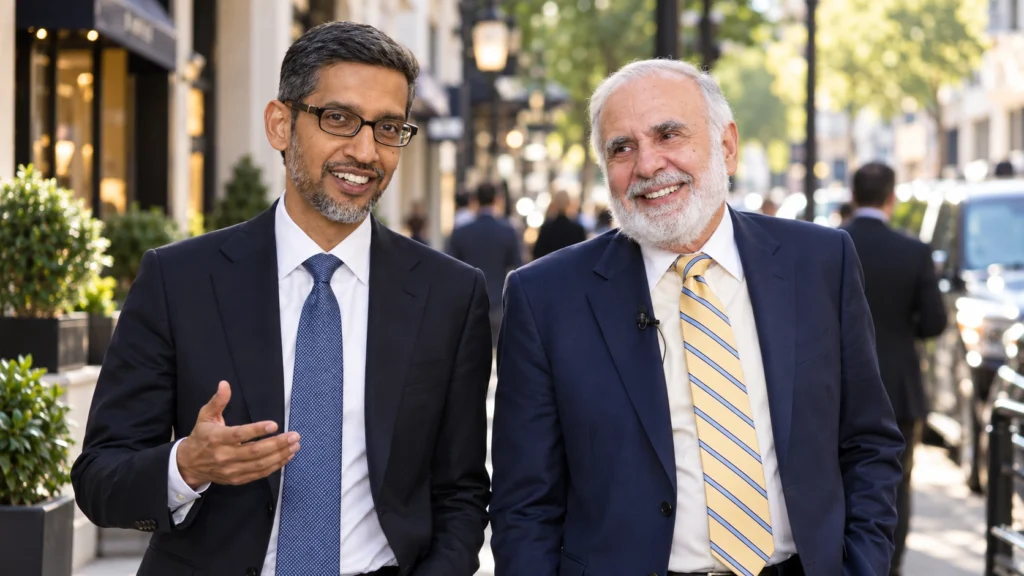
The names Sundar Pichai and Carl Icahn are sometimes searched together because their professional histories intersected during Google’s acquisition of Motorola Mobility. However, they come from very different areas of the business world. Pichai built his career in technology and eventually became CEO of Google and Alphabet, while Icahn became widely known as an investor
The names Sundar Pichai and Carl Icahn are sometimes searched together because their professional histories intersected during Google’s acquisition of Motorola Mobility. However, they come from very different areas of the business world. Pichai built his career in technology and eventually became CEO of Google and Alphabet, while Icahn became widely known as an investor and shareholder activist. Their connection is mainly linked to Google’s Motorola transaction rather than a documented personal partnership or joint business venture.
Understanding the timeline helps explain why these two names appear together. In 2011, Google agreed to acquire Motorola Mobility for about $12.5 billion. At the time, Icahn was a significant Motorola shareholder with an interest in the company’s valuable patent portfolio. Pichai was already a Google executive, although he was not the company’s CEO at that time. The available public record therefore points to an indirect corporate connection rather than direct collaboration between the two men.
Who Is Sundar Pichai?
Sundar Pichai is one of the most recognizable technology executives in the world. He joined Google in 2004 and worked on several important products, including Google Chrome and other major platforms. His responsibilities expanded as Google grew, eventually leading to his appointment as Google CEO in 2015. In 2019, Pichai also became CEO of Alphabet, Google’s parent company, giving him responsibility for a much broader technology and business organization.
Pichai’s professional background is primarily connected with technology leadership, product development, and corporate management. His education includes the Indian Institute of Technology Kharagpur, Stanford University, and the Wharton School. His career demonstrates a gradual rise through Google’s management structure rather than an investment-focused path. This distinction is important when examining Sundar Pichai and Carl Icahn, because Pichai’s role during the Motorola period was that of a Google executive, not an activist investor or independent shareholder.
Who Is Carl Icahn?
Carl Icahn is a prominent American investor known for acquiring substantial stakes in companies and pushing management or boards to consider strategic changes. His investment career has covered numerous industries, including technology, manufacturing, energy, and consumer businesses. Rather than operating primarily as a corporate executive, Icahn has generally exercised influence through ownership positions and shareholder activism.
Icahn’s connection with Motorola Mobility provides a useful example of this approach. During the period surrounding Google’s acquisition, Icahn and related entities held a significant stake in Motorola Mobility. He communicated with the company’s management about alternatives involving its patent portfolio. His involvement was therefore based on his position as a shareholder and investor. This is fundamentally different from Pichai’s role as a technology executive working within Google.
The Motorola Mobility Connection
The strongest documented link between Sundar Pichai and Carl Icahn comes from Google’s 2011 agreement to acquire Motorola Mobility. Google was interested in Motorola partly because of its extensive patent portfolio, which had strategic importance during a period of intense competition in the smartphone industry. Motorola also had an established position in mobile hardware and was closely connected to the Android ecosystem.
Carl Icahn was already an important Motorola shareholder during this period. His interest in the company’s patent assets created another strategic perspective around Motorola’s future. Google’s proposed acquisition eventually moved forward, with the company agreeing to pay approximately $12.5 billion. Although Pichai was working at Google during this period, available transaction records do not establish him as Icahn’s direct negotiating counterpart.
Why Motorola’s Patents Were Important
Motorola’s patents were particularly significant because the smartphone industry was becoming increasingly competitive. Technology companies were involved in disputes involving intellectual property, operating systems, hardware, and software. A large patent portfolio could provide defensive protection and strengthen a company’s position when dealing with competitors. Google’s interest in Motorola therefore went beyond simply acquiring a traditional smartphone manufacturer.
Icahn also recognized the potential importance of Motorola’s intellectual property. His communications with Motorola management included discussions about exploring alternatives for the company’s patent portfolio. This created an interesting overlap between Google’s strategic interest and an investor’s interest in asset value. The situation helps explain why Sundar Pichai and Carl Icahn can appear together in discussions about Google’s Motorola acquisition and the broader history of Android.
Did Sundar Pichai and Carl Icahn Work Together?
There is no well-established public evidence showing that Sundar Pichai and Carl Icahn worked together as business partners or jointly managed a company. Their professional positions were fundamentally different. Pichai was a Google executive involved in technology and product leadership, while Icahn was an outside investor with a substantial ownership interest in Motorola Mobility. For more: Jill Tavelman: Biography, Age, Family and Career
The Motorola transaction should therefore be described carefully. Google and representatives connected with Icahn discussed matters relating to the acquisition and shareholder interests, but that does not establish a direct working relationship between Pichai and Icahn. Public transaction documents identify other executives and representatives involved in the negotiations. This distinction prevents the Motorola story from being presented as a personal partnership between the two men.
Google’s Acquisition of Motorola Mobility
Google announced its agreement to acquire Motorola Mobility in 2011 for approximately $12.5 billion. The transaction was completed in 2012 after receiving the necessary approvals. One major attraction was Motorola’s patent portfolio, which could strengthen Google’s position as Android continued expanding across the global smartphone market.
The acquisition also gave Google direct ownership of a major mobile-device manufacturer. However, Google eventually decided to sell Motorola Mobility’s handset business to Lenovo in 2014 for approximately $2.91 billion. Google retained the majority of Motorola’s patents as part of the broader transaction structure. This later development shows why the original acquisition should not be judged solely by comparing the purchase price with the later handset sale.
Pichai and Icahn Represent Different Business Roles
The careers of Sundar Pichai and Carl Icahn demonstrate two very different approaches to corporate influence. Pichai’s career developed inside Google, where he moved from product responsibilities into senior management and eventually became CEO. His influence comes primarily from executive leadership, technology strategy, organizational management, and decisions affecting Google’s global products and services.
Icahn’s influence comes largely from investment ownership and shareholder activism. When he holds a substantial stake in a company, his position can give him an important voice in discussions about corporate strategy and asset value. His Motorola involvement illustrates this model. Comparing these roles provides useful context because the two men were influential in very different ways, even though their professional histories intersected around a major technology transaction.
What the Public Record Shows
The available corporate records provide important context for understanding Sundar Pichai and Carl Icahn. Motorola’s filings documented Icahn’s significant ownership position and his communications with company management concerning strategic alternatives for its patent assets. The same transaction history records Google’s interest in acquiring Motorola Mobility and the negotiations surrounding the eventual deal.
Those records do not establish Pichai and Icahn as direct business partners. Pichai was an executive at Google during the period, but his later position as Google’s CEO should not be projected backward onto the 2011 transaction. The documented facts support a narrower conclusion: their professional paths intersected through Google’s acquisition of Motorola Mobility and the corporate events surrounding that transaction.
Why Their Connection Still Gets Attention
The search interest around Sundar Pichai and Carl Icahn is understandable because both names are associated with major areas of business influence. Pichai represents one of the world’s largest technology companies and its development across search, advertising, cloud computing, artificial intelligence, Android, and consumer products. Icahn represents a very different model centered on investment ownership and shareholder activism.
The Motorola acquisition brought these different worlds into the same corporate story. Google wanted strategic technology and intellectual-property assets, while Icahn had a financial interest in Motorola as a significant shareholder. Looking at the situation from both perspectives provides a clearer understanding of the transaction without turning an indirect connection into an unsupported claim of personal collaboration.
FAQ
Are Sundar Pichai and Carl Icahn business partners?
There is no well-documented public evidence that Pichai and Icahn are business partners. Their main connection comes from the wider Motorola Mobility acquisition involving Google and Motorola.
Did Carl Icahn work for Google?
No. Icahn was an investor and significant Motorola Mobility shareholder. His involvement in the Motorola story came through his ownership position rather than employment by Google.
Did Sundar Pichai negotiate with Carl Icahn?
Public transaction records do not establish Pichai as Icahn’s direct negotiating counterpart. Other Google executives and representatives were involved in the acquisition discussions.
Why are Pichai and Icahn mentioned together?
Their names are connected through Google’s acquisition of Motorola Mobility. Icahn was a major Motorola shareholder, while Pichai was already working at Google during that period.
What happened to Motorola after Google’s acquisition?
Google completed the Motorola acquisition in 2012 and later agreed to sell Motorola Mobility’s handset business to Lenovo in 2014. Google retained most of the patents.
Conclusion
The connection between Sundar Pichai and Carl Icahn is best understood through the history of Google’s acquisition of Motorola Mobility. Pichai was a Google executive during the period, while Icahn was a significant Motorola shareholder with an interest in the company’s strategic assets. Their roles were different, and available public records do not establish them as personal business partners.
The Motorola story remains an important chapter in the history of Google, Android, mobile technology, and corporate investment. It also shows why understanding business timelines and individual roles matters when researching well-known executives and investors. Readers interested in this topic can explore related coverage of Google’s major acquisitions, Android’s history, Motorola Mobility, and Carl Icahn’s investment activities for additional context.



















Leave a Comment
Your email address will not be published. Required fields are marked with *