
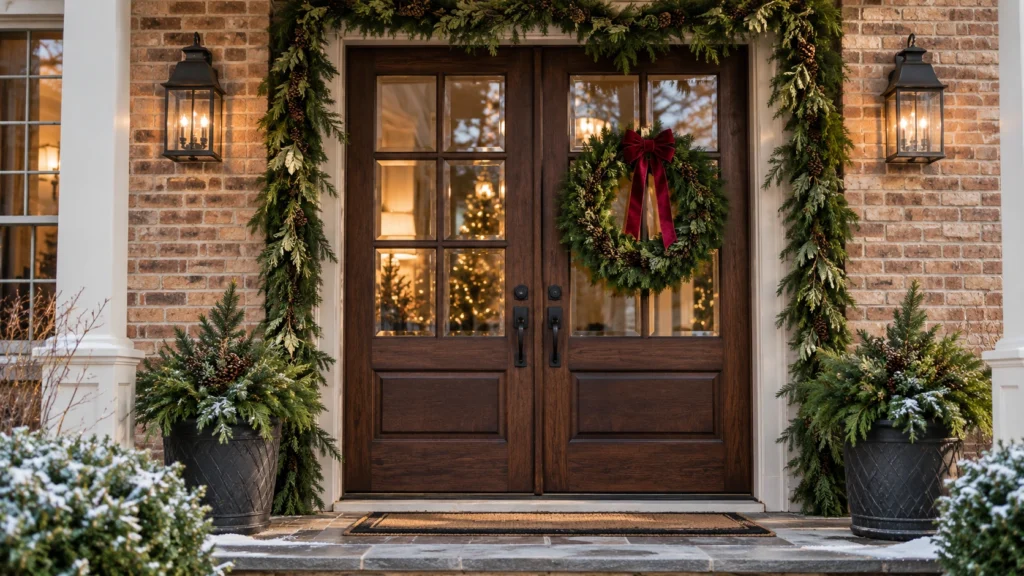
There is an unspoken assumption that outdoor Christmas decoration is a volume competition, and that a house either commits fully or does not participate. A great many people who would quite like to mark the season on the outside of their home decide, on that basis, to do nothing at all. This seems a shame,
There is an unspoken assumption that outdoor Christmas decoration is a volume competition, and that a house either commits fully or does not participate. A great many people who would quite like to mark the season on the outside of their home decide, on that basis, to do nothing at all.
This seems a shame, because the quieter version is not only easier and cheaper, it is frequently better.
Why Dark Months Need Something at the Door
The practical argument for decorating the outside of a house in December is not really about Christmas. It is about arriving home in the dark.
For roughly two months, most people in the UK leave for work in low light and return in none. The front door, in that period, is something you approach in the dark, fumble at, and get through as quickly as possible. A lit wreath or a lantern on the step changes that transaction entirely.
There is reasonable evidence that small environmental changes affect how we feel through winter, and the Mental Health Foundation’s guidance on looking after yourself during the darker months covers the broader picture of light, routine and mood. A decorated front door is not a treatment for anything, but it is a small, cheap intervention at precisely the point in the day when the dark is most noticeable.
One Good Wreath Does Most of the Work
If you do one thing, make it the wreath, and make it bigger than you think.
The most common mistake in door wreaths is scale. A wreath that looks substantial when you are holding it looks apologetic on a standard front door viewed from the gate. As a rough guide, a wreath should occupy around half to two-thirds of the width of the door panel.
Beyond size, the things that separate a good wreath from a poor one are density and texture. A sparse ring with a few decorations wired on reads as thin. A dense base with several types of foliage, varied texture and a limited palette reads as expensive whether it was or not.
Light, Not Lights
The restrained approach treats light as a single warm source rather than as a quantity.
A pair of lanterns on the step with battery candles inside. A single string of warm white lights woven through a garland over the door. A low-level uplight on a planter. Any of these does more for the appearance of a front door at seven in the evening than two hundred cool white bulbs along a gutter.
Warm white, always, in this style. Cool white reads as clinical against brick and render, and it fights with the warm light spilling from inside the house, which is the thing you are trying to complement rather than compete with.
Plants Are the Quiet Option
Winter containers either side of a front door are the most under-used outdoor decorating idea available, and they last from November until March rather than for six weeks.
Skimmia with its red buds, variegated ivy trailing over the rim, white cyclamen, hellebores, dogwood stems for vertical structure and a few sprigs of spruce pushed in for scent. A pair of those flanking a door looks considered in December and still looks good in February, when everything plastic has been packed away. For more: Sidney Hicks: Biography, Career, Wife, and Family
They also have the advantage of being alive, which matters more than it sounds in a season otherwise dominated by plastic and electricity.
Choosing Pieces That Will Last
The restrained approach only works if the few pieces you use are good, because there is nothing else to distract from them.
That means buying for durability rather than for a single season: wreaths with a solid base rather than a wire ring, garlands with a dense core, figures in materials that will not fade or go brittle, and anything electrical properly rated for outdoor use.
Garden centres tend to be a better bet than supermarkets for this, because the construction is built around repeated seasonal use. Dobbies carries a reasonably broad outdoor range, and it is worth looking at the heavier, better-made end of it on the basis that three good pieces kept for a decade will cost less and look better than a boxful of thin ones replaced every other year.
Think About the Birds
One genuine consideration for anyone decorating a front garden is wildlife, particularly if your decorating involves cutting back, stringing lights through shrubs or hanging things in trees.
Avoid decorating anything that is actively being used for shelter, keep artificial cobweb-style materials and loose tinsel out of the garden entirely, since they tangle around small birds, and leave hedges alone. The RSPB has straightforward advice on supporting garden birds through winter, and a feeder near a lit door is arguably a better seasonal addition than another illuminated figure.
Taking It Down
The quiet approach has an underrated advantage in January, which is that it does not leave a ruin.
When the wreath comes off and the lanterns come in, the planters stay, and the front of the house looks intentionally planted rather than stripped. The transition out of Christmas is as gradual as the transition in, and nothing sits there looking abandoned in the second week of January.
The Materials Question
A restrained scheme invites a closer look at what things are made of, since there are fewer pieces to hide behind.
Natural materials weather well and look better as they age: wicker, dried seed heads, pine cones, real foliage, jute twine, galvanised metal. Thin plastic and printed card do the opposite, and after three weeks of British weather the difference is obvious from the gate.
This is not an argument against anything artificial, since good artificial foliage is now extremely convincing and lasts for years. It is an argument against the cheapest end of the market in a scheme where every piece is on show.
Scent at the Door
One element that costs almost nothing and is consistently overlooked: smell.
A few sprigs of genuine spruce or fir worked into an artificial wreath will scent the area around a front door for weeks, particularly in cold air. Dried orange slices, cinnamon sticks and bay leaves wired into a garland do something similar at close range. It is the detail guests notice without being able to identify why the entrance feels more welcoming than the decoration alone would suggest.
One Change a Year
A quiet scheme builds well over time if you add a single considered piece each season rather than a boxful.
A good wreath in year one. A pair of lanterns in year two. Proper planters in year three. Within a few winters you have a coherent set of well-made things that look like they belong together, acquired at a pace that never required a significant outlay in any single December.
Enough Is a Legitimate Aim
None of this is an argument against the maximalists, whose streets are genuinely joyful and whose displays raise substantial sums for charity every year.
It is an argument against the idea that the only alternative to a full display is nothing at all. A good wreath, a pair of lanterns and two decent planters will take an afternoon, last for years, and make arriving home in the dark measurably more pleasant for two months. That is a reasonable return on a modest effort.




















Leave a Comment
Your email address will not be published. Required fields are marked with *